CharlesBerger
Forensic Scientist
Biography

Charles Berger is Principal Scientist at the Netherlands Forensic Institute (NFI) and Professor of Criminalistics at Leiden University. His work focuses on forensic evidence interpretation and inference, particularly the application of logic and probability in forensic science.
At the NFI, Charles is involved in education, research, and research strategy. He supports forensic experts, advises management, contributes to the institute’s scientific quality and development, and conducts his own research, which is published internationally.
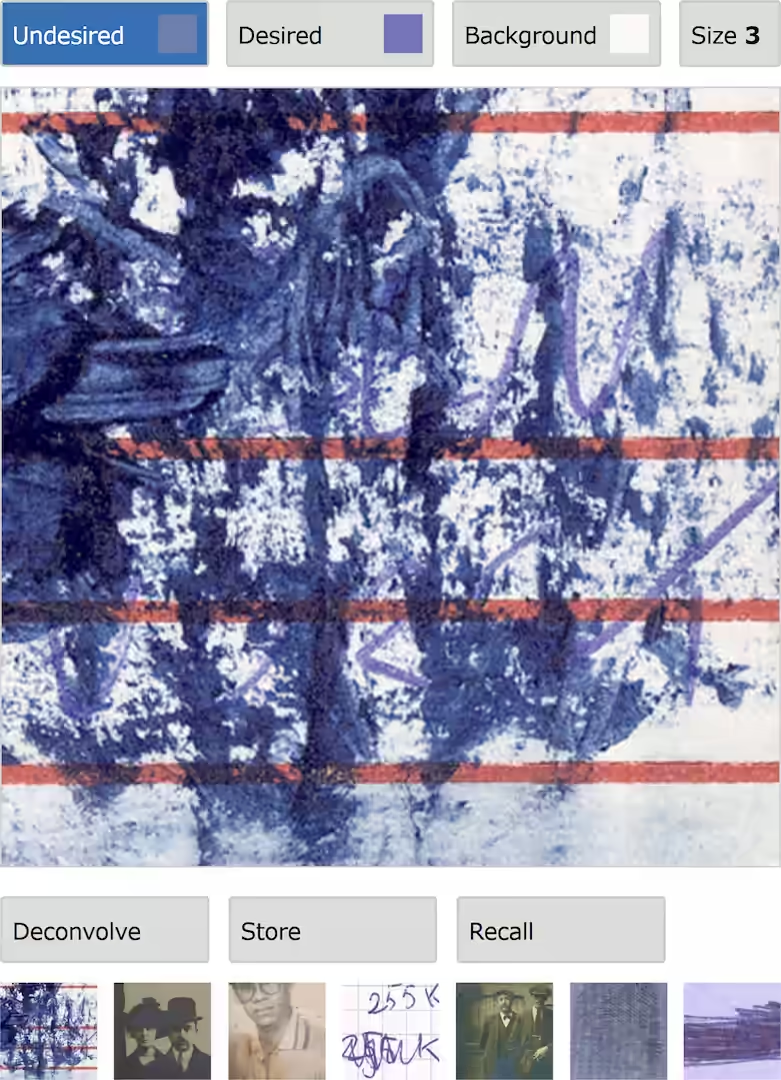
Charles has a background in the exact sciences and holds a PhD in Applied Physics. He began his career as a forensic document examiner at the NFI, developing e.g. color deconvolution as a powerful method for color separation in forensic image processing. Try this color deconvolution demo or apply it to your own images with the online color deconvolution app.
Becoming principal scientist in 2007, he developed into a forensic science generalist focusing on interpretation. He was instrumental in the NFI’s adoption of logically correct reporting and a common opinion scale across all forensic disciplines in 2010. In 2015, he contributed to the ENFSI Guideline for Evaluative Reporting, which sought to promote similar improvements at the European level.
Charles co-authored “Interpreting Evidence” (2016), a widely used reference work on forensic interpretation. In 2018, he became lead editor of ISO 21043-4, the international forensic science standard on Interpretation, which was published in 2025. He currently leads an ENFSI direct grant project that supports the implementation of the ISO 21043 forensic science standards.
Throughout his career, Charles has worked to improve the theory, practice and communication of forensic interpretation. This requires explaining the logic of forensic interpretation clearly and effectively to all participants in the criminal justice system. Working at the interfaces of science, policing, and law, he finds this both challenging and rewarding.
He sees forensic interpretation as the core of forensic science as a unified science: it is what the various areas of expertise have in common, and it is what makes forensic science distinct from chemistry, biology, physics, computer science, or medicine. The ISO 21043-4 standard for forensic interpretation demonstrates how the fundamental question of what observations mean for the central propositions in a case is shared by all areas of expertise within forensic science.